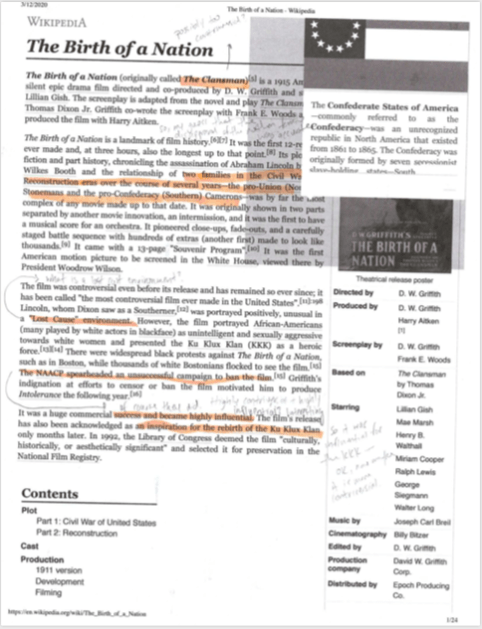
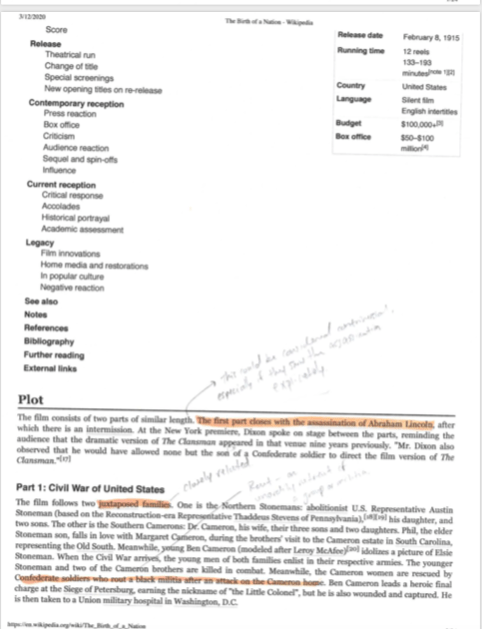
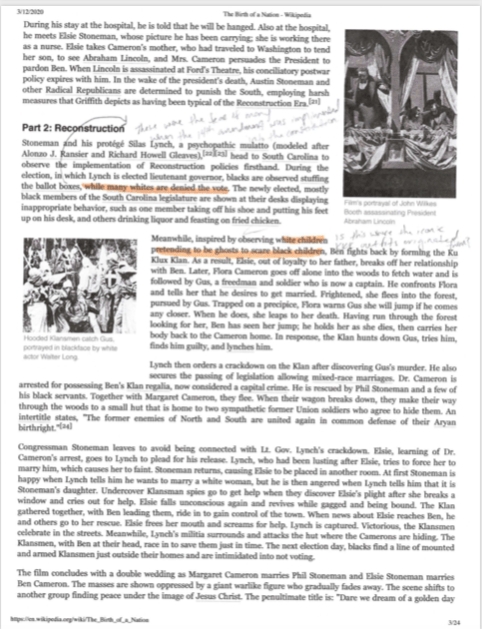
I noticed that in the beginning (before the scenes of the cotton fields) , the film showed the charismatic charm that the family had for one another. They all seemed to live well off, and seemed that there were not a lot of big worries in the worlds. I did pick up on one odd bit where the guy places the cat on to the puppy, and the scene states “hostility”. Then the cat scratches the dog. Was this meant to portray the two totally different animals living under one house as an enemy of sorts. Or two species that had been domesticated over time to live with another but evolve a natural aversion toward one another? (Like blacks and whites were seen at the time). Also, another thing I did notice was that (what I think was) the owner of the plantation was happy to see his slaves dancing during the rest period, but his visiting kin was not. He was shaking his head. Was this an expression of disappointment toward his kin and the owner of the plantation in which he didn’t see as fit to take care of? Or was it on the contrary? Maybe the visiting kin was from the North, and viewed slavery, in general, as something immoral. One last thing I noticed was that at the end, when the slaves were dancing, I think some of those “black people” were actually white people with black paint on their face and arms (like a minstrel show).
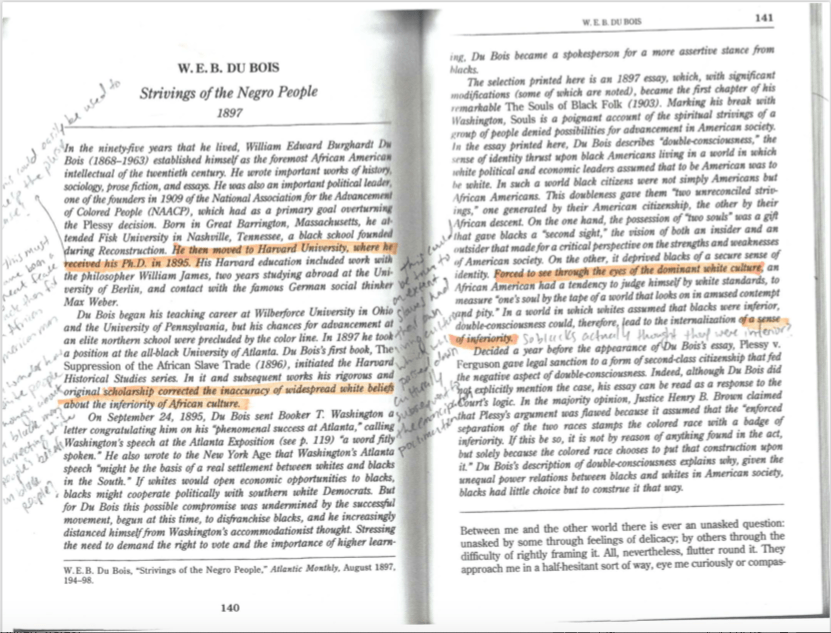
Look for 6 conceptualizations and what kind of discourse community Du Bois is discussing and/or part of.
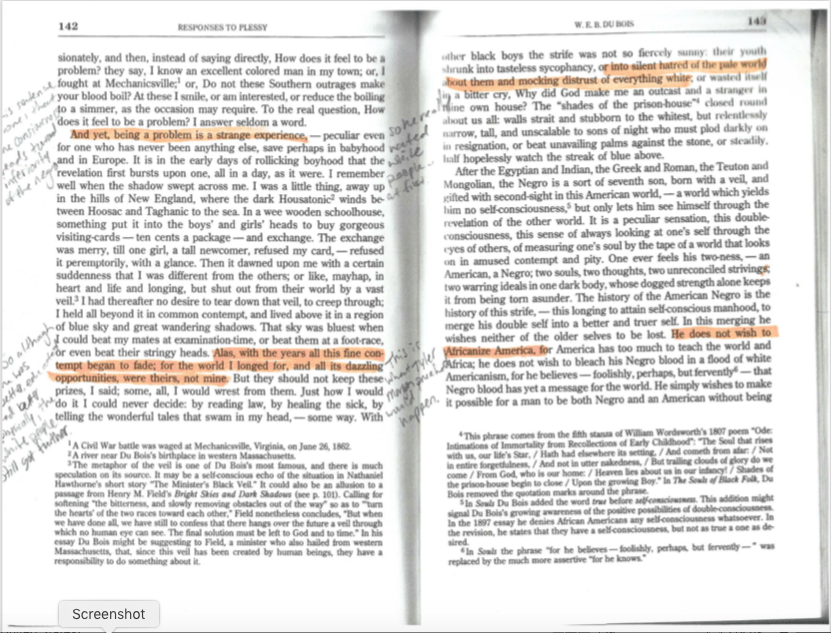
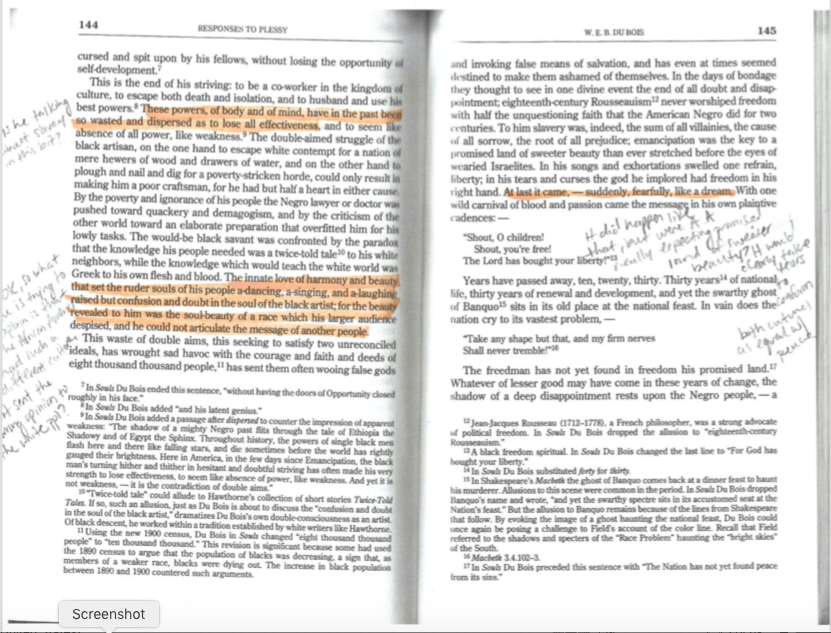
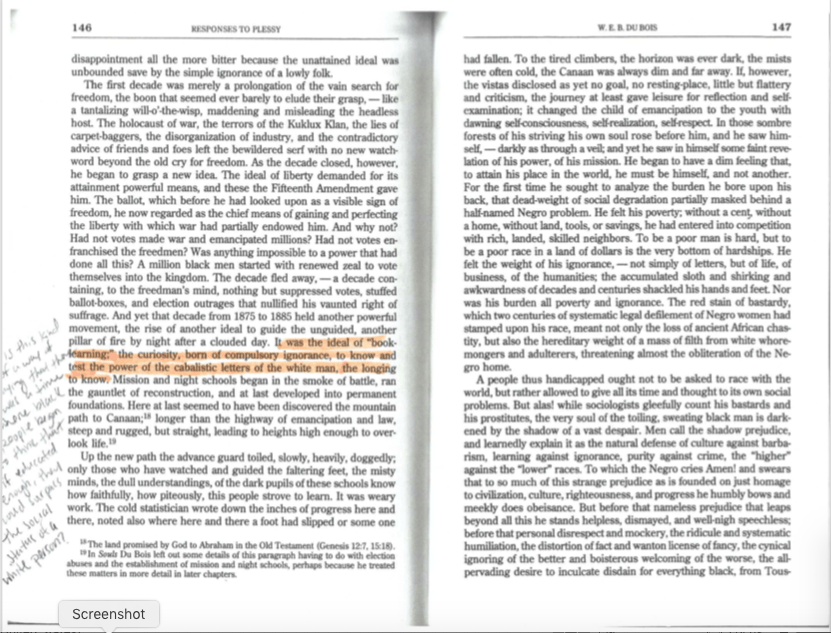
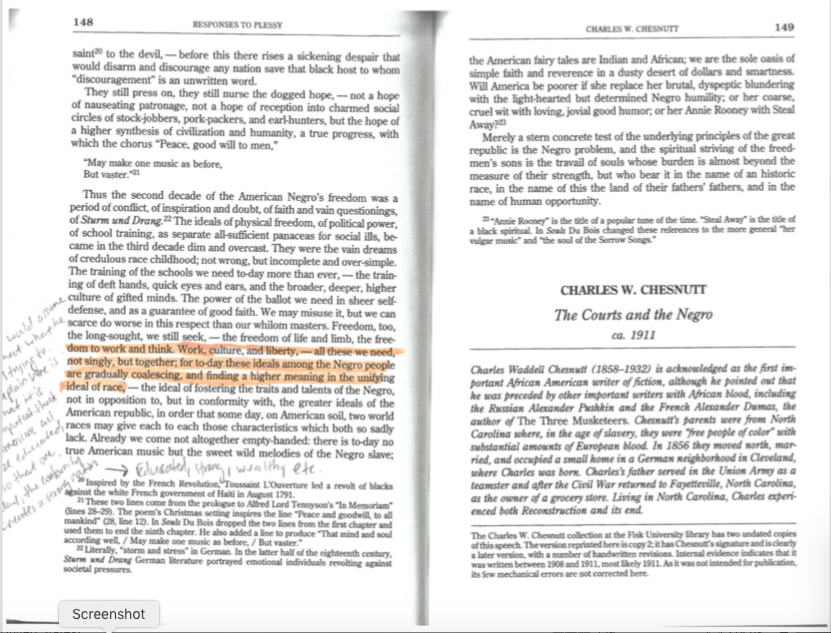
In Du Bois’s essay, his shared common goals are ones that are common with activist in his time, trying to move the United States forward away from the idea of second class citizenship and double-conscious. If he were to try to convince anyone through his plea, it would be those that are educated, fence sitters, politically affiliated.
Du Bois uses a specific lexis, which is a highly educated dialect. Using this form of lexis in a plea, in order to convince highly educated and/or political affiliates would be a good idea during the late 20th century and early 21rst century when most of the South and some north was illiterate. If he proves to have obtained an education and have a wide vocabulary, he could establish himself, not only as a member of the white educated and /or political affiliated discourse community, but a black member of the white educated and/or political affiliated discourse community. This integration would be a huge step toward coalescence of social and racial groups.
There is definitely a thresh hold level of members in a highly prestigious school such as Harvard. For Du Bois to be admitted there was a huge step into being integrated in a highly educated discourse community, especially at a predominantly white school. And to be the first African American to earn his phd there took it to another level.
All of these conceptualizations would eventually lead Du Bois to be one of the founders of a completely separate discourse community which only included highly educated, African American activists.
Du Bois was born into a speech community that was seen as inferior to white people. His objective was to leave his speech community and integrate himself into a discourse community of highly educated white scholars and political affiliates. But he would not forget his roots of shared linguistic forms, shared regulative rules and shared cultural concepts. It was then, once he was integrated and accepted, that he would plea and (at the same time) inform the discourse community he was now part of that the speech community (that he was born and raised in) had been convinced of the idea that they were naturally inferior due second hand citizenship.
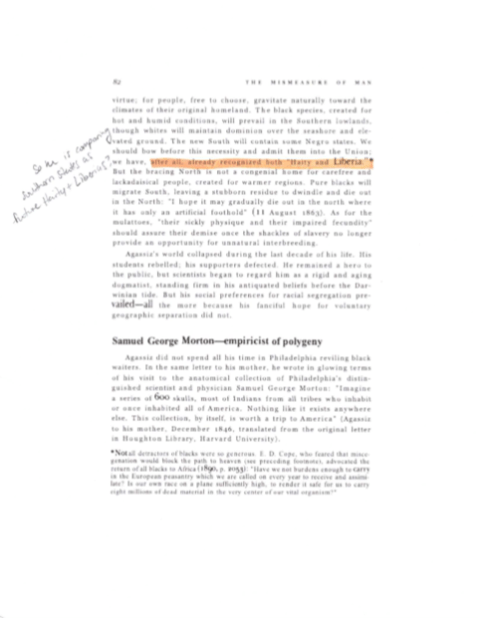
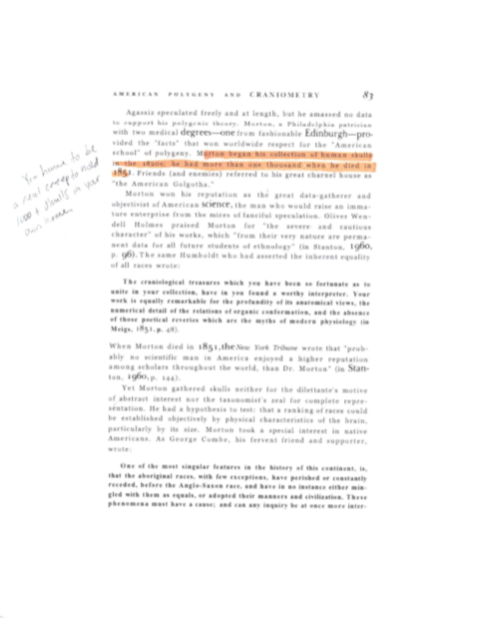
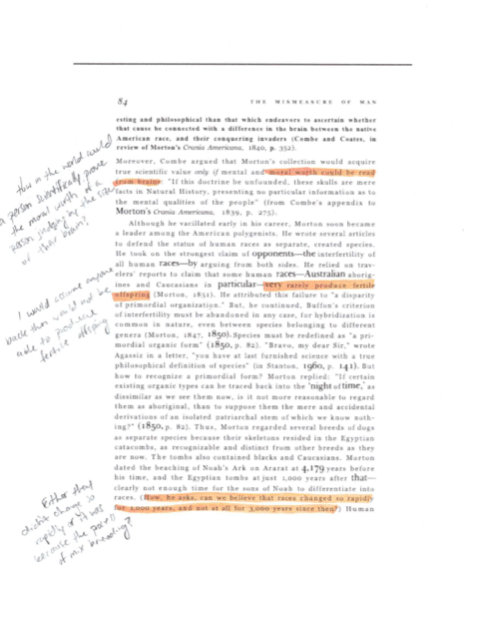
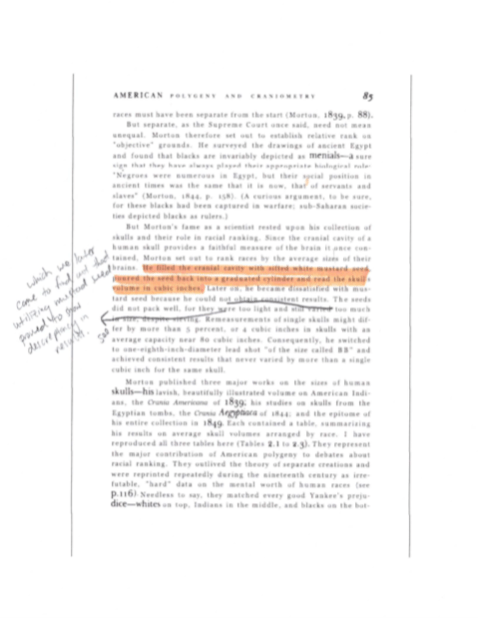
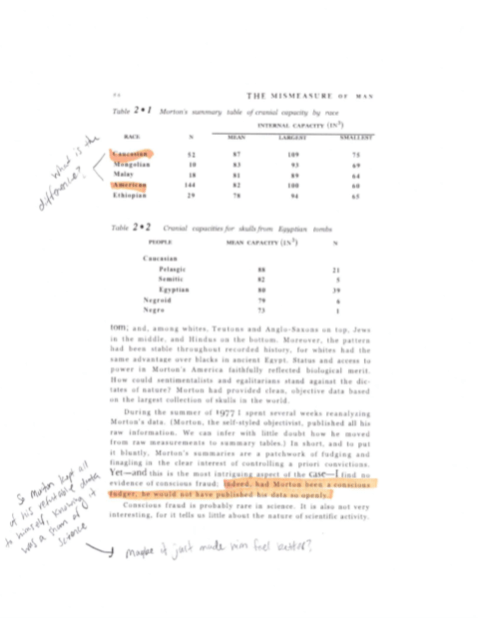
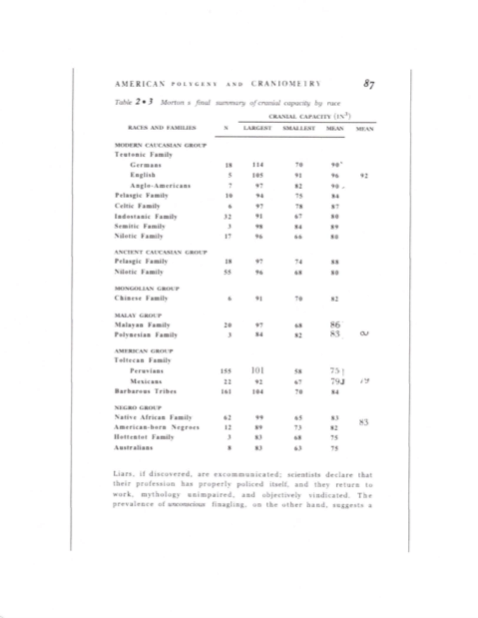
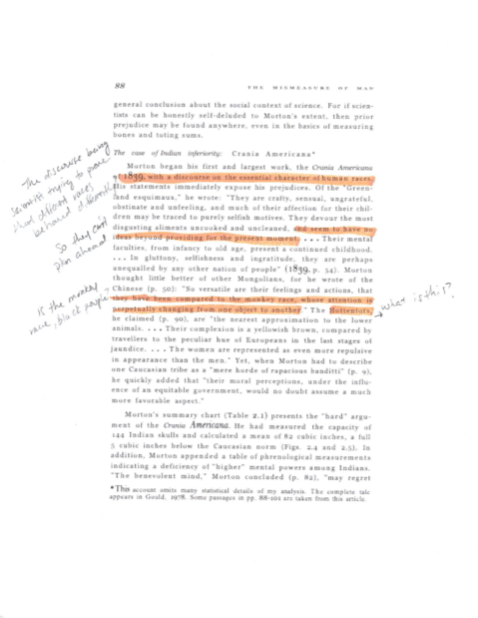
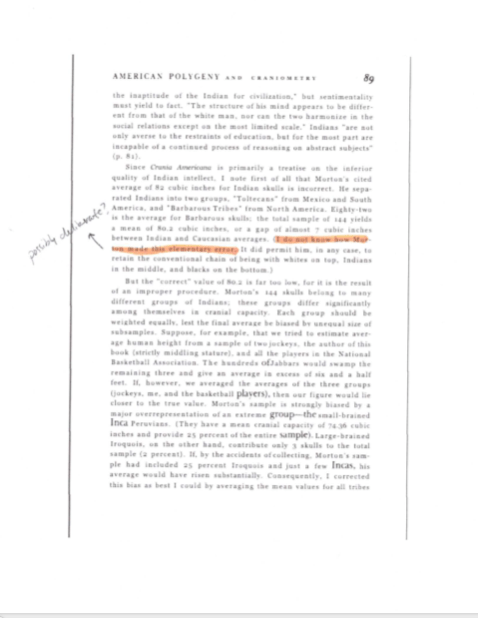
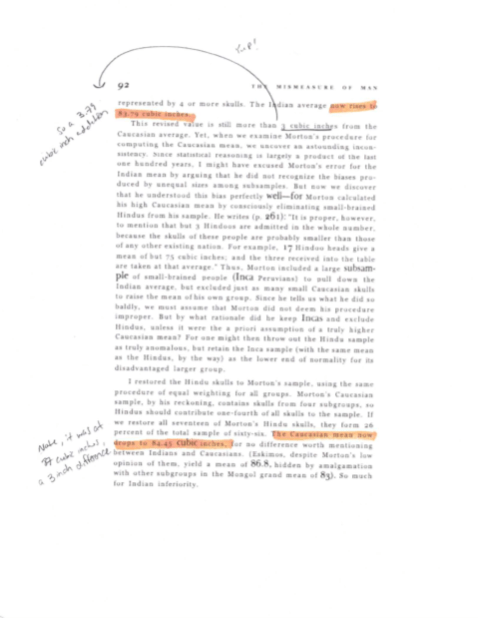
A year subsequent to the infamous Plessy v. Ferguson Supreme Court case, W.E.B. Du Bois had written an essay that had articulated his own personal recollections of the inferiority he had felt growing up as an African American in a predominantly white America. Mixed with emotion and assertiveness, Du Bois’s essay is geared toward the aftermath of the Plessy V. Ferguson case. Although it was never explicitly proclaimed by Du Bois that his essay was a response to the case itself, it still shined light on how the court’s ruling lead to more stringent laws pertaining to the separation of blacks and whites, which ultimately stamped a badge of inferiority to the black race and fed the negative idea of double-consciousness. As Jim Crow laws became stricter and prejudices were growing stronger by the day, an essay like Du Bois’s seemed to be a last cry for help, almost like an emotional plea for coalescence amongst the two races. Furthermore, glorified scientist and anatomists of the 19th century (such as Samuel Morton and Etienne Serres) had successfully brainwashed the minds of millions of people with their theories of why races were inferior to one another. With that being said, it was vital for a man of Du Bois’s educated and political status to sway those who were either, convincing the world of such scientific fallacies, or those who were striving to reinforce the restrictions on Jim Crow laws in order to promote equality and dismantle the sanction of second class citizenship in the United States.
Reason 1. His essay is emotional. A scholar could easily write a run of the mill essay that states the main points of why he believes that America is going in the wrong direction in terms of second class citizenship, instead Du Bois chooses to use personal references and sympathy to open the eyes of his audience.
Reason 2. Being an educated black man fortifies his voice. If it was black man who was uneducated and had poor diction, his audience would most likely look passed him. Also, at the time, many people were convinced of the fallacies that scientist and anatomists were theorizing. It would take an educated man (being black is a plus in this) to convince those people (fence sitters) of a contradictory belief.
Reason 3. Du Bois was politically affiliated. Although he didn’t establish the NAACP until 1909, his political ideals and influence stuck with him prior to becoming a political leader. This helped give his essay credibility when discussing anything referencing equal but separate and Jim Crow laws and/or second-class citizenship.
I believe that the readers are possibly white politicians, white law affiliates and/or white fence sitters, in general, that are wondering where to proceed with the race problem within the United States. The gap is that white people had embedded the thought through time, that black people were naturally inferior, and it was practically unnatural for the African American in that time to think otherwise. This was due to the “double consciousness” of conflicting African descent to the white culture over time. This overall paradigm eventually lead African Americans to actually believe that they were naturally inferior to white people.
He is claiming that although black people and white people are inherently different in some ways, it more important to focus on the future of coalescing the two races to form a stronger bond on United States soil.
I read the contract and I cannot think of anything that needs to be included or revised. The only thing I could think of is that sometimes people (like me) will come in late due to arbitrary factors that we cannot control. Example: I go to your class from work and sometimes I get caught up in something (at work) which makes me late to your class. Some other issues that may cause us to be late are traffic, late shuttle. etc. Anyways, the issue that I have been noticing is that you take attendance right at the strike of 3:30 and the times I have walked in a few minutes late, I have been counted absent. Because of this, I had to either remind you to check me there at the end of class or email you. My suggestion to you is that you 1. Wait 10 or so minutes to make sure everyone is there (although this may be inconvenient) or 2. Pass around an attendance sheet midway through class. This really isn’t a big issue, but when I’m late to your class due to being held up at work, I have to remind myself to remind you to check me in. I know the obvious response to this would be “Just show up on time!”. But sometimes I really don’t have a choice but to be a few minutes late. I don’t know if this falls under the genre of the contract… But I had to write something to make this homework section looked filled out so at least I accomplished that..
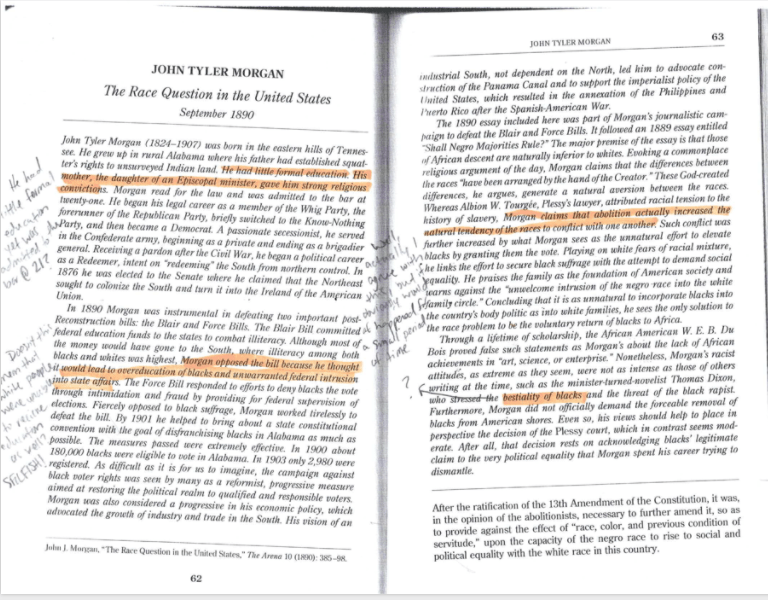
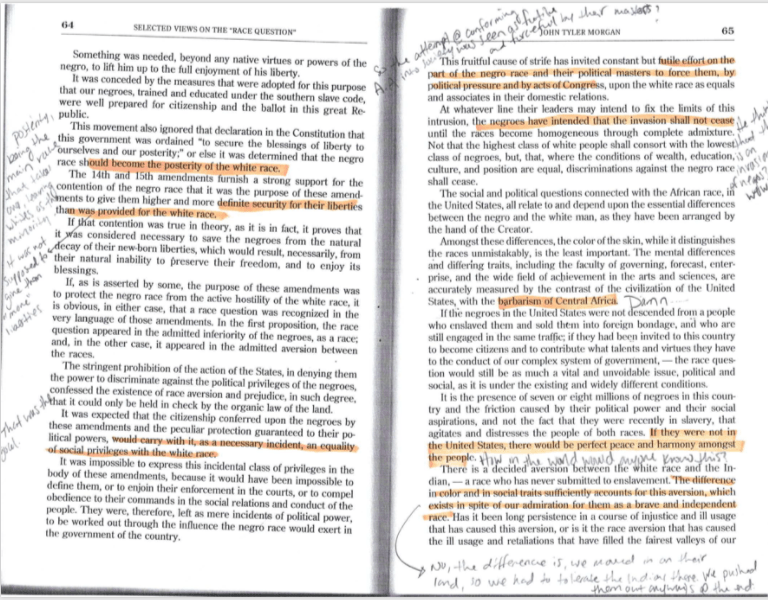
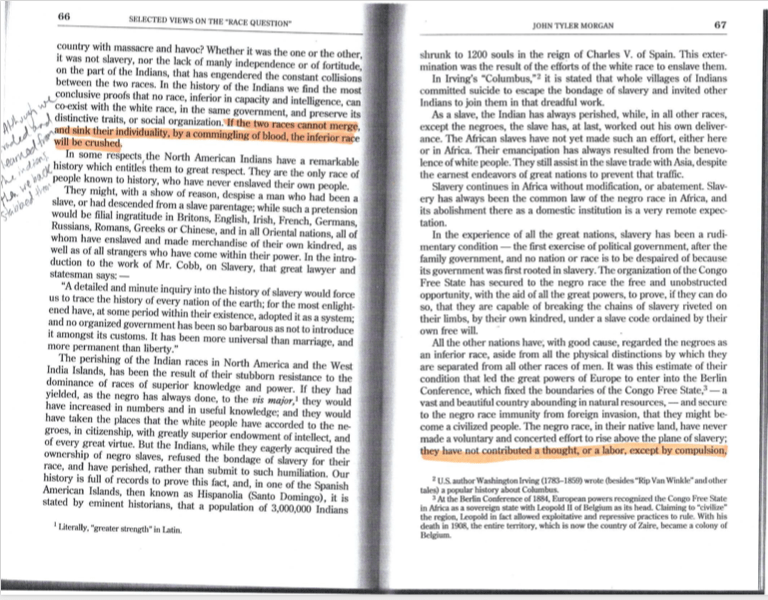
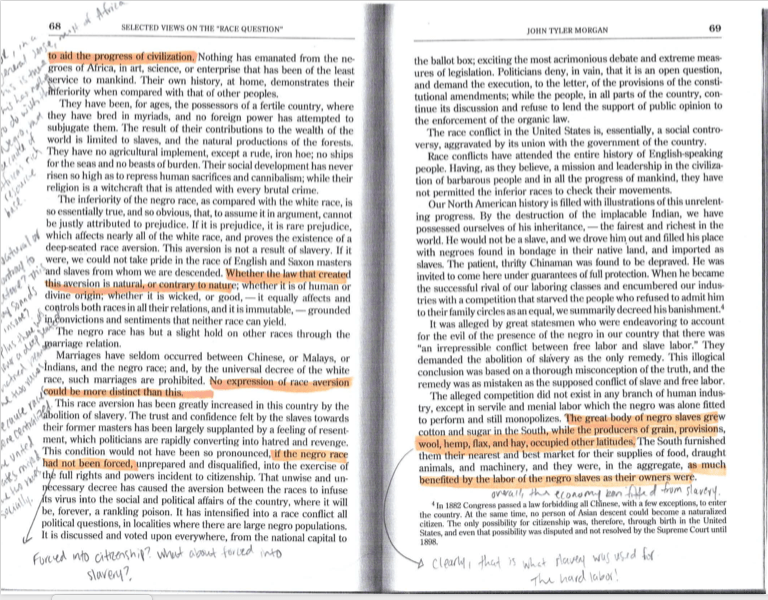
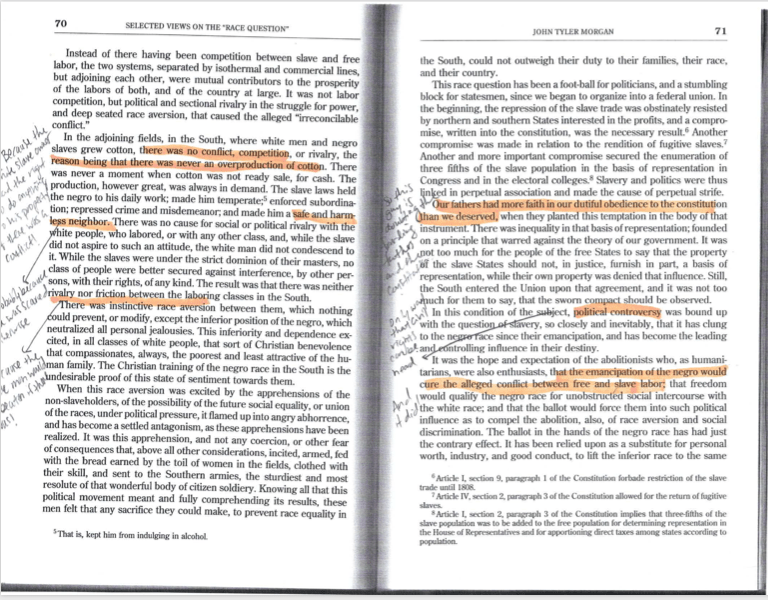
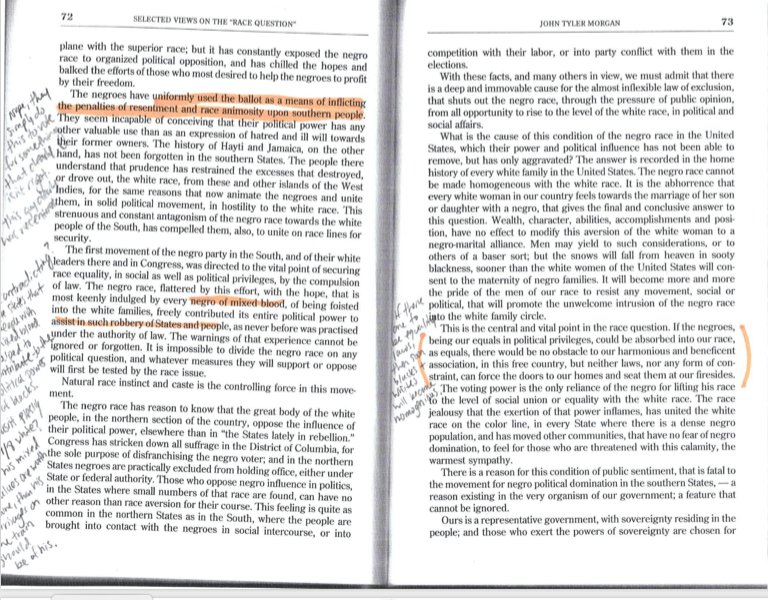
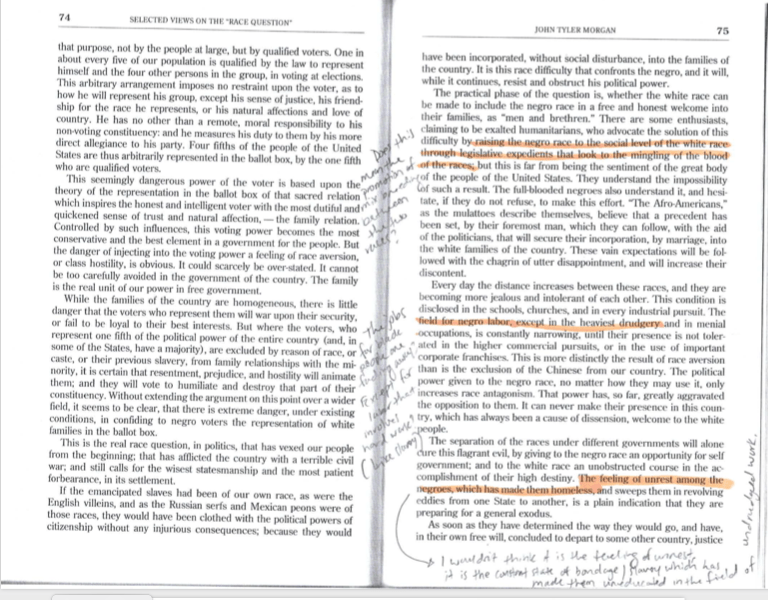
The claim, I believe is that there had always been a race aversion naturally for thousands of years and that blacks are inherently of a lower status than whites. He also tries to convince his readers that blacks were practically forced to conform with white people, which had created more strife and hardships for the black person.
His reasons most likely stem from his religious upbringings mixed his extreme conservative political views. He mentions in the passage that there could be a chance that the African American could vote their way to forming a group that outliers the white person and creates them as an inferior race to the African American. This outlandish thought could have been a reason to convince his readers that allowing citizenship to African Americans was a bad idea.
The evidence comes from testimony of Morgan himself. Some quotes include:
“The fruitful cause of strife has invited constant but futile effort on the part of the negro race and their political masters to force them, by political pressure and by acts of Congress, upon the white races as equals.”
“This condition would not have been so pronounced, if the negro race had not been forced, unprepared and disqualified, into the exercise of the full rights and powers incident to citizenship.”
“No expression of race aversion could be more distinct than this.”
No counter argument and no rebuttal. His counter argument could be him saying that the founding fathers created a constitution in order for us to have freedoms, but we unfortunately took it out of context.
The readers, I believe, are supposed to be politically involved during reconstruction of the South and/or regular white folks who are possibly involved in the abolition of black suffrage. The gap is supposed to questions that nobody had answers to considering the race question. The gap was more of a rant that was set out to convince people that providing citizenship to slaves had created a stronger race aversion than what was already naturally embedded since way back when.
African Americans if allowed to vote, Morgan believed, would become more separated to whites and it was possible that they could create their own government with a mass anarchy. It was also possible that if black people became as status equal, then they would convince the general population that it was ok to interbreed.
Morgan uses fear when trying to convince his readers that African Americans could possibly abuse their power with obtaining voting rights.
 Welcome to Django Dog. The Home of Blogs